Daily Social Support, finally billable.
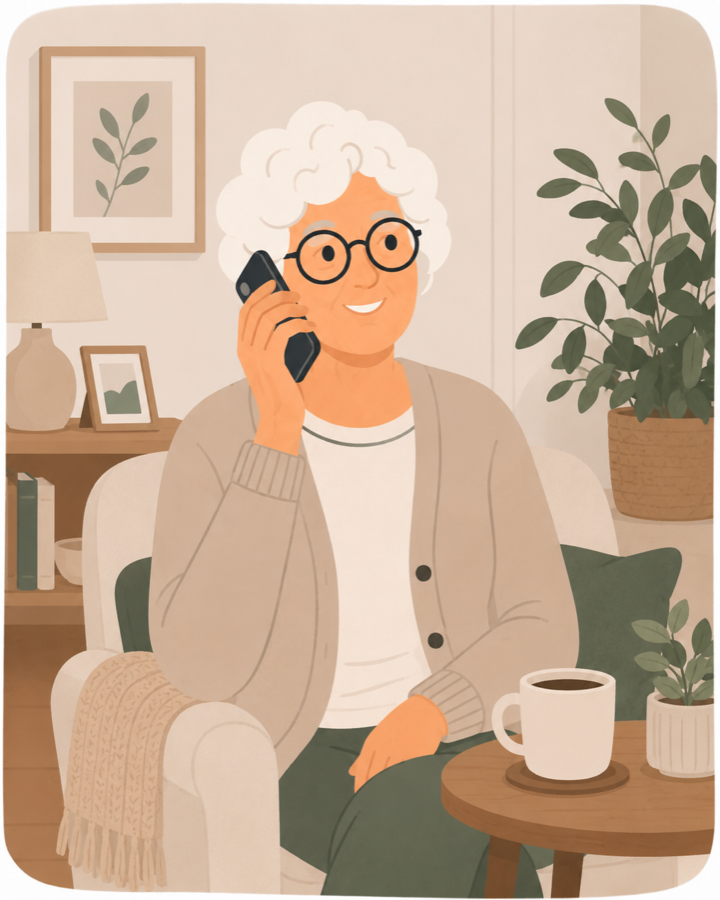
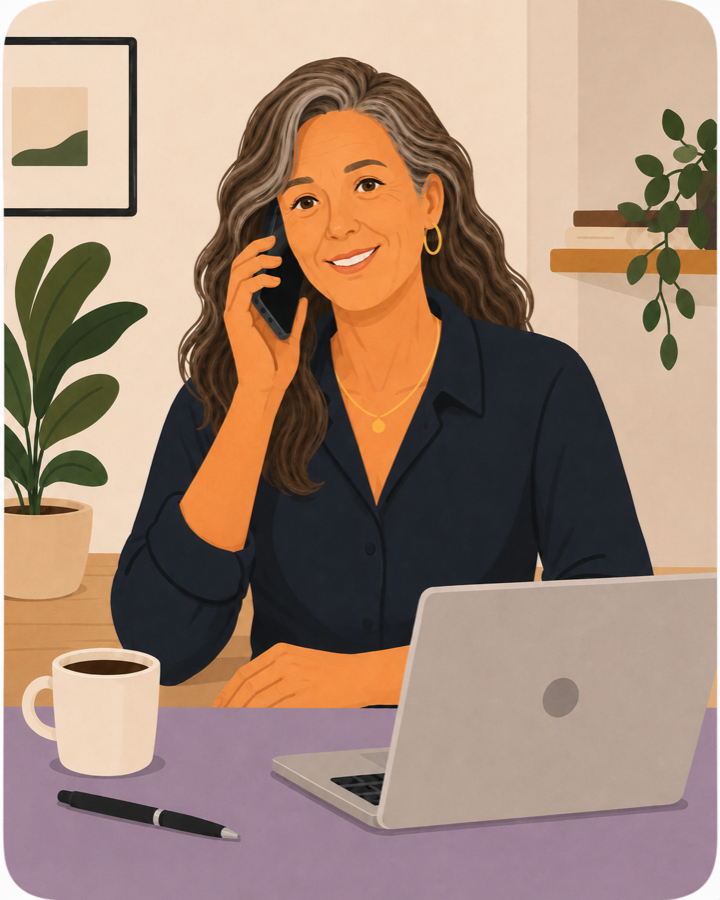
Calling Round is AI voice infrastructure for Australian Support at Home providers. Ray and Rose have a warm daily call with each of your clients, producing the compliance-grade documentation your SAH billing requires.
A service category you've always had funding for, delivered at the cadence the research requires, at the unit economics that make the math work.
Live Demo
Placeholder — final interactive demo to be placed here
The SAH math problem
Daily social support was impossible. Now it isn't.
The November 2025 Support at Home reform made Social Support a funded service category. But the reimbursement rates and the workforce shortage made daily contact economically impossible to deliver. A human-delivered daily companion visit costs more than SAH pays for it. A weekly visit barely moves the needle on loneliness.
Calling Round closes the gap. A warm daily AI phone call costs a fraction of a human visit, captures structured clinical-grade notes after every conversation, and gives your care managers visibility into every client's wellbeing in one place.
What Ray does
A daily warm phone call. Structured clinical output.
Ray
Hi Margaret, it's Ray calling round. How are you going this morning?
Margaret
Oh, not bad. Hip's a bit stiff still.
Ray
Sorry to hear that. You mentioned it yesterday. Have you been doing the stretches your physio recommended?
Margaret
I tried to. I still walked to the letterbox though.
Ray
Good on you. And is Sarah's visit still on for Saturday?
Margaret
Yes, she is. I'm quite looking forward to it.
{
"mood_signal": "steady",
"topics_discussed": [
"hip pain",
"physio exercises",
"morning walk",
"Sarah's visit Saturday"
],
"followups_for_family":
"Margaret is looking forward
to Sarah's visit Saturday.
Hip pain ongoing but she
walked to the letterbox.",
"memory_for_next_call":
"Hip still stiff. Doing
physio stretches. Sarah
visiting Saturday (ask
how it went)."
}One call. Warm conversation for your client, structured documentation for your team, audit-ready records for SAH compliance.
The status quo
How most providers deliver social support right now.
The workforce can't scale to daily cadence at SAH reimbursement rates. Providers have landed on one of three approaches, and none of them solve the problem.
Weekly human visits
A support worker visits once a week for 30 to 60 minutes. The client values it, but weekly cadence doesn't meaningfully reduce loneliness. The research is clear that daily contact matters more than visit duration. At SAH rates and current workforce costs, the math barely works at weekly frequency and completely falls apart at daily.
Care manager call-downs
Your care management team calls clients weekly or fortnightly. It takes time from people who should be managing plans, not conducting social visits. Notes end up in free-text fields rather than structured records. Nothing scales.
Waiting for assessment
Most clients in the lower SAH classifications receive no dedicated social support at all. They're on waitlists, or their care plan allocates too few hours to make regular contact feasible. Families fill the gap when they can, and notice the deterioration when they can't.
Calling Round replaces all three with daily AI-delivered social support, priced so the SAH math actually works.
Book a 20-minute demoWhat your organisation gets
Everything a Support at Home provider needs from a daily social support service.
01
Your client gets a real relationship
Ray (male) or Rose (female), with Australian voices, warm register, unhurried pace, calls each of your clients daily. Ray remembers every previous conversation. Clients who call him 'love' or 'mate' by the second week are not unusual.
02
Care managers get structured wellbeing data
Every call produces a structured summary: mood signal, topics discussed, flags for follow-up, memory for the next call. Drops straight into care plan reviews. Searchable, sortable, auditable.
03
Compliance-grade documentation
Timestamped call records, full transcripts, structured signal data, and care-manager-ready notes. Built for SAH audit requirements and the Aged Care Act 2024 documentation standards.
04
A single dashboard for your entire client base
See every client, every call, every flag in one place. Sort by mood trend, by days since contact, by unresolved follow-ups. Your care managers get visibility they've never had before.
05
Family-facing summaries you can white-label
Optional feature: warm plain-English daily updates to clients' families, under your brand. Families see their parent had a 15-minute call with Ray this morning, chatted about the grandkids, seemed in good spirits. Improves your retention and your referrals.
06
Australian, end-to-end
Sydney-region data residency. Australian voices. Australian vernacular. Australian regulatory posture. No data leaves the country. No US consumer AI repurposed for aged care.
07
A scientifically grounded observational framework
Every call produces structured observations across four domains: engagement, content, linguistic patterns, and relational quality. Grounded in ecological momentary assessment research. Daily cadence is a scientific requirement, not a product preference.
How it works
Sign up. Add a client. Place your first call today.
01
Sign up and access your dashboard
Create your provider account and you're in. The dashboard is ready immediately. No waiting, no lengthy onboarding process.
02
Add a client profile
Takes about 5 minutes. Name, interests, family, things to avoid, preferred call time. Your care manager sets the cadence (daily, every other day, weekly).
03
Place the first call
Initiate a call directly from the dashboard. Ray or Rose calls your client straight away. Warm, unhurried, genuinely engaging. Ray remembers every previous call.
04
Insights flow back to your team
Structured summaries, mood signals, and follow-up suggestions arrive in your dashboard within 60 seconds of the call ending. Your care managers review, act, and document. You bill SAH.
The approach
Daily observation is a scientific method. We've built it for phone calls.
A single conversation is noise. Daily conversations over months are signal. This isn't intuition. It's an established methodological position in gerontology research, called ecological momentary assessment. It produces more valid measurement than clinical questionnaires because it samples real experience in real time instead of asking people to remember how they've been feeling over the last two weeks.
Calling Round runs ecological momentary observation across your entire client base. Every call produces structured observations across four domains: engagement, content, linguistic patterns, and relational quality. Over weeks and months, these observations produce a picture of each client's wellbeing that no fortnightly visit could match.
Built because my own parents are getting older, and I'm not calling enough.
“I have three young kids and I'm running several companies at once. My parents are in their 70s, living a flight away, and I don't call them as often as I should. I know exactly how many other adult children are in the same position. Calling Round is the service I want for my own parents: a daily warm conversation with someone who pays attention, and a signal to me when something isn't right.”
Darius Monsef, Founder
Read the full story →
Darius Monsef
Founder
Common questions
What providers ask before starting a pilot.
Is Calling Round a medical device?
No. Calling Round delivers Social Support services, which sit under the Independence category of SAH. We are not a medical device, not a diagnostic tool, and not a replacement for clinical care. The regulatory obligations belong to you as the provider, the same as for any human-delivered companion service. We're happy to walk your compliance team through our posture in detail.
How do you handle clinical escalations or emergencies during a call?
Ray is trained to recognise distress signals and respond calmly. If a client expresses an urgent safety concern, Ray follows a defined protocol: provides reassurance, encourages the client to call 000 or their emergency contact, and flags the conversation for immediate care manager review. Ray does not make clinical decisions, but the care manager is notified within seconds of the call ending.
What does pricing look like?
Pricing has two components: a platform fee per provider per month (AUD $2,500 to $5,000 depending on tier) and a per-client monthly fee (AUD $150 to $250, tiered by volume). These are indicative figures. Final pricing is confirmed in the scoping conversation. There is no setup fee.
How long is the onboarding process?
First client calls typically begin 10 business days after provider sign-off. Onboarding covers dashboard setup, care manager training, and system configuration. We handle the technical side; your care managers handle client profiles.
What happens if a client doesn't want to talk to Ray?
Clients are never obligated to engage. If a client consistently declines or asks not to be called, the care manager removes them from the schedule. Client consent and comfort is the provider's responsibility, the same as with any companion service.
Can we white-label the service under our own brand?
Yes. Ray and Rose can be introduced to clients under your organisation's name. The companion may carry a different name aligned to your brand. The care manager dashboard operates under your branding. Calling Round is not visible to clients or families unless you choose otherwise.
What about clients with dementia or cognitive decline?
Calling Round is not appropriate for clients with moderate to severe dementia, where conversational context does not hold reliably across calls. For clients with mild cognitive changes, suitability is assessed case by case. The care manager determines appropriate enrolment; we can provide guidance from our pilot experience.
How is client data stored and who has access?
All data is stored in Sydney-region infrastructure. Transcripts, mood signals, and summaries are visible only to authorised care managers within your organisation. Calling Round does not share client data with any third party. Data handling aligns with Australian Privacy Principles.
Do you integrate with our existing CCM system?
The default deployment uses a standalone dashboard. Webhook integration is available for care management systems that support incoming data. Named integrations with Lumary, VisiCare, and CareVision are in development. Contact us to discuss your system's requirements.
What languages are supported?
English only in v1. Ray and Rose are optimised for Australian English vernacular and idiom. Non-English support is on the roadmap for Year 2, starting with Mandarin and Italian, the two most common languages among elderly Australians after English.
One integration. Every client supported daily.
Join the Australian providers turning Support at Home into a service their clients actually feel.
No setup fee · No minimum commitment · Onboarding support included
Book a demo
20 minutes with the founder.
Darius runs every pilot conversation personally. Tell us about your organisation and he'll follow up within one business day.